
Estimated reading time: 6 minutes
Church strategic planning is an important part of the creation, development, and growth of a ministry.
Churches that are interested in growth are not exempt from planning.
Church planning helps the organization map out strategic steps to achieve its mission and vision.
Ministries can experience a level of success without a plan, but those who invest the time and resources into developing a specific strategy and plan can achieve success at a much quicker pace.
Strategic planning is a church’s process of defining its strategy and making decisions for allocating its resources (people, time, and money) to pursue this strategy.
4 Steps to Church Strategic Planning
1. Create a Vision, Mission and Values Statement
It is difficult to know where to focus efforts and resources without articulating what you are trying to do.
Imagine taking a vacation without first deciding where you are going or how you will get there.
The first and arguably most important step of the strategic planning process is to create a church vision, mission, and values statement.
This process allows board members and church leaders to clarify why the church exists (mission) and what the church is trying to achieve (vision).
The mission and vision is what determines strategy, planning, and budgeting church resources.
2. Do (SWOT) Analysis
A SWOT analysis is a great exercise to go through because it identifies the key areas of the church that may need targeted resources as well as opportunities or opposing environmental factors that could affect church strategy.
For example, if a children’s program is a strength of the church, there may need to be continued or increased resources committed to it to ensure continued development and growth.
On the other hand, if the church is located in a high-crime area, there might be an opportunity to develop a youth outreach program to support that unique demographic.

The SWOT analysis process can help identify many great ideas to help target development, growth, and improvements.
To begin the SWOT process, think about the following:
- Strengths: Characteristics of the church that may give it an advantage over others;
- Weaknesses: Characteristics of the church that may be a disadvantage as related to others;
- Opportunities: Conditions outside the church that could potentially increase attendance or revenues;
- Threats: Conditions outside the church that could create problems for the church.
For example:
- Strength: The church is located on a busy street and has high visibility in the community.
- Weakness: A small percentage of the church population is young families.
- Opportunities: The church is located in an area with a high population of Hispanic families.
- Threats: The church is located in a small town with an aging population.
3. Perform Gap Analysis
A gap analysis answers the question, “Where are we compared to where we want to be”? The process looks at the vision – where do we want to go – and compares it to where we are currently.
The analysis can be in relation to ministry program development, discipleship, financial viability, or customer experience.
All areas will be identified and targeted for strategy through the gap analysis process.
An example of a church’s current state:
- The church is renting a temporary facility until it can build a permanent building;
- The church is lacking volunteer leadership;
- The church children’s program is lacking weekly training curriculum;
- The church lacks a process for discipleship.
4. Write Organizational Goals
Once a SWOT and gap analysis is done, it is time to start writing goals.
Goals are only as effective as the formalized process of achieving them.
Many organizations use the SMART (specific, measurable, attainable, realistic, timely) goal process to ensure their goals are achievable. When writing a goal, filter it through the following questions:
Specific: Is the goal specific enough for clarity?
Measurable: Is there a way to measure the success of the goal?
Attainable: Is the goal truly attainable?
Realistic: Is the goal realistically written?
Timely: Is there a timeline associated to the goal to ensure a completion date?
Church Goal example: Sample Church will develop a volunteer leadership training program and implement it by the 3rd quarter 20xx.
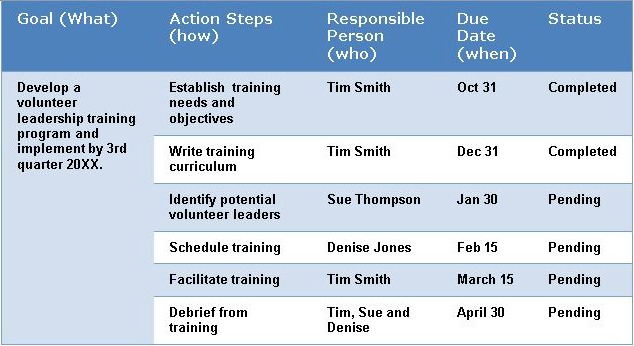
Now, if we look at this example, we need to ask the following questions:
- Is it specific – yes: keywords will identify, develop and implement
- Is it measurable – yes: keywords, develop by 3rd quarter 20xx
- Is it attainable – yes, with ample resources
- Is it realistic – yes: within the allotted time frame
- is it measurable – yes: keywords, by 3rd quarter 20xx
Now, let’s take this a step further and create a goal document. Unless a goal is assigned to someone and is accomplished, it is merely words on paper.
When someone is responsible for completing a goal and is managed by a structured performance management process, goals have a much better chance of being completed.
This is obviously an oversimplified example of a church goal, but it provides a framework for identifying tactical steps and assigning accountability.
Church Budget Is Important
The church budgeting process is also incorporated into strategic planning as each goal needs to have identified resources (people, time, money) devoted to it to be successful.
The strategic planning process should deliver a document that details organizational goals for the short term (3-6 months) and long term (1-3 years).
This living document should be updated as conditions and priorities change.
The most important part is writing it down and assigning responsibility – whether an employee or volunteer – to assign the task.
The beauty of having a written plan is that once all of the time and effort is invested in the plan, it is just a matter of overseeing the plan to completion.
This is done through a structured performance management process and should be monitored and reviewed at least annually. Once a strategic plan is written with organizational goals, it is time to develop departmental and employee goals.
Does your church have a strategic plan for success?
If you would like to learn more about church planning and administration, check out our Smart Church Management: A Quality Guide to Church Administration book on Amazon.
Turn Strategic Planning Into A Fun Game!
Another great resource to help is from our friends at Focus Strategy Game. This strategic planning tool developed specifically for churches can help you facilitate a Strategic Planning Session while having a fun, insightful time with your team. No facilitator is needed. Just play the game!
I have worked with this tool and it is a great, affordable, and fun approach to strategic planning for those churches that don’t have the resources to hire a consultant to help. The best part is when you finish the game, you have a written plan.
My friends at Focus Strategy Game are offering you a $25 discount if you use coupon code SMARTCHURCH25.
You can check out Focus Strategy Game here. Don’t forget to use the coupon code SMARTCHURCH25 to get $25 off of your order.
Tip: If you decide to play this game, use this article to help jump-start your strategic planning ideas!
If you try it, I’d love to hear your feedback!


